

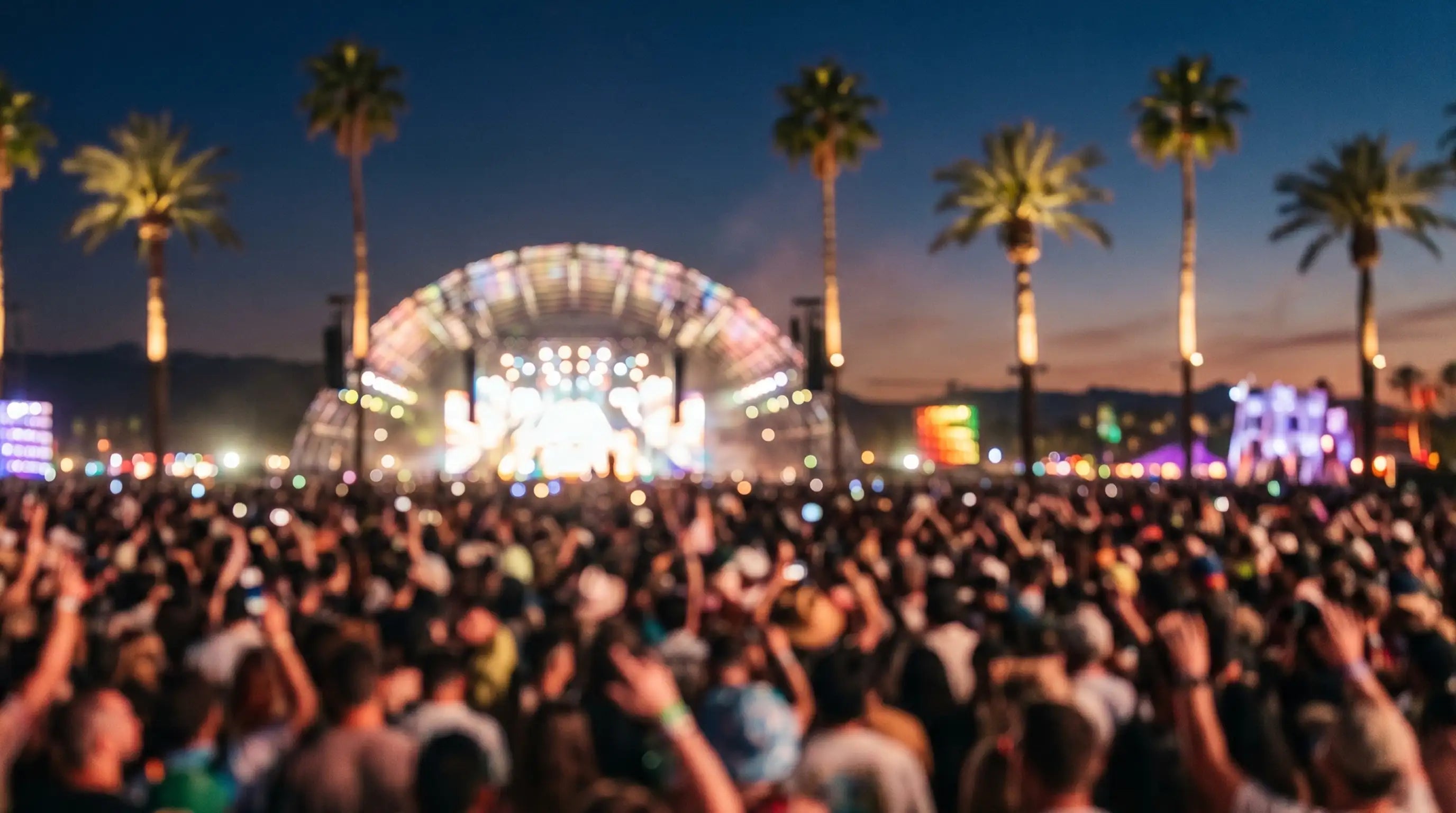
The Day 3 Problem
You're home from Bonnaroo. The wristband is still on your wrist because you haven't decided whether to cut it off yet. You pull up the lineup on your phone, sit on the couch, and try to walk back through the weekend in order.
Friday is mostly fine. You remember the opener you caught by accident on your way to find water. You remember the late-night set that ran past 2 a.m. Then you hit Saturday, and something weird happens. You genuinely cannot remember whether you saw Phoebe Bridgers on Friday afternoon or Saturday afternoon. You know you saw her. You remember crying during one specific song. You remember the friend who handed you a napkin. You just cannot place which day it was, and the more you try, the more the days start trading details back and forth like they're playing cards.
This is the festival memory problem. It is different from forgetting a single show. It has its own mechanism, and once you understand it, the fix is pretty obvious.
Why Festivals Blur: The Memory Science
Three things are working against you at every multi-day festival, and they compound.
First, encoding overload. A four-day festival like Bonnaroo or Glastonbury can put you in front of 20+ acts across the weekend if you're hustling between stages. Your brain encodes new experiences into long-term memory through a process that takes time and attention. When you stack 20 events into 96 hours, you're asking your hippocampus to do the work it would normally do for one concert per month, twenty times over, in four days. It cannot keep up. Most of it gets stored shallow or not at all. (We get into the deeper mechanics in The Science of Concert Memories, which is worth reading if you want the full picture.)
Second, sensory fatigue. Encoding memory is metabolically expensive. By Day 2 of Coachella in 100-degree heat, you're dehydrated, sunburned, walking 8 to 12 miles a day, and probably sleeping five hours a night in a tent or a cheap Airbnb. Every one of those things impairs the neural processes that turn experience into memory. The walk from Stage 2 to the dance tent in 95-degree heat with 40 minutes of battery left is not a memory you're encoding well. You're surviving it.
Third, retrieval interference from set similarity. This is the sneaky one. Festivals are full of structurally similar events: hour-long sets, same crowd type, same general production, same vibe. When you try to retrieve a specific memory later, your brain pulls up the cluster of similar memories at once and they cross-contaminate. The Saturday DJ set borrows the lights from the Sunday DJ set. The indie band on Friday borrows the harmonies from the indie band on Sunday. By Day 3 you genuinely can't remember if the bass drop you loved was Friday or Saturday, because the file in your head is labeled "festival bass drop" with no timestamp.
Why "I'll Remember Later" Fails Worse at Festivals
At a single show, you have a generous encoding window. Two or three hours, one event, you go home, you sleep on it, and your brain has space to consolidate. Even if you don't journal until the next morning, you have a fighting chance. (This is why the 5-minute post-concert rule works for single shows.)
At a festival, that math breaks. You have 20 events competing for the same encoding window. The forgetting curve, the well-documented Ebbinghaus finding that we lose roughly 50% of new information within an hour if we don't reinforce it, hits harder and faster because there's no quiet space for consolidation. You finish one set and immediately walk to another. You sleep four hours, drink coffee, and walk into Day 2. The brain never gets the gap it needs.
This is why people who say "I'll remember the highlights" come home from Lollapalooza with three real memories and a vague feeling that the rest was good. The highlights they remember are usually the headliners, which means they lost the side-stage discovery sets. Those are usually the ones that mattered most. The 11 a.m. band on the small stage that became your favorite of the weekend is the exact set the forgetting curve eats first.
Position: if you do not document during the festival, you are not going to remember most of it. Not the details, not the order, not which day was which. You will remember the feeling, and the feeling will become indistinguishable from the feeling of every other festival you've been to.
What to Lock Down Per Set: Five Micro-Fields
You do not need to write an essay per set. You need five fields. Three minutes per set. That's it.
- Artist. Obvious, but write it down. Your future self will not remember the spelling of the act you caught by accident.
- One specific moment. Not the whole set. One thing. The drop, the cover, the crowd singing, the band stopping the song to point at someone in the front row.
- One specific song. The song you'll associate with this set forever. Not the setlist. One song.
- Who you were with for THAT set. Festival groups split and rejoin constantly. The friend you saw the headliner with might not be the friend you saw the noon set with. Write down who was actually there for this one.
- One detail that differentiates it from any other set at this festival. This is the anti-blur field. The detail that makes this set unmistakably this set: the dust on someone's boots, the guy who proposed during the encore, the set you sat down for because your feet were destroyed. Without this field, the sets cross-contaminate. With it, they stay separate forever.
Five fields. Three minutes. Done.
The Window That Matters: Between Sets, Not After the Festival
Here is the position most festival content gets wrong: documentation has to happen on-site. The car ride home is too late. The plane home is too late. Even the day after is too late.
The latest acceptable window is the hotel or campsite that night, before you sleep. Ideally you're jotting between sets, while you're standing in line for water or sitting through a 20-minute changeover. The reason is simple: sleep deprivation between Days 1 through 4 compounds encoding loss. You will sleep less than usual every night of the festival, and each night of bad sleep further impairs your ability to retrieve what happened earlier. By Day 4 you cannot accurately remember Day 1. Not because you didn't experience it, but because your brain has been running a sleep deficit for 72 hours and the early stuff is gone.
If you wait until you're home from ACL on Monday morning, you are reconstructing, not remembering. You're filling in plausible details. Some of them will be wrong, and you will not know which ones.
The Anchor Set
You cannot deep-dive on 20 sets. Nobody can. Trying is how this becomes a chore and how people give up by Day 2.
Pick one anchor set per day. The set that hit hardest, the one you'll want to write about properly. That one gets the full treatment: paragraph, photos, the why behind why it mattered. The other 4 to 6 sets you saw that day get the five-field minimum. Three minutes each.
Over a four-day festival that's four anchor sets and roughly 20 short entries. That is achievable. That is what the difference between documenting a festival and pretending to document one looks like.
The Tool Question
You can do all of this in a notebook or the notes app on your phone. A spreadsheet works fine, technically. The problem is you won't actually open the spreadsheet on Day 3 when your phone is at 8% and your feet are bricks.
This is where Festival Mode earns its place. You add the days you attended, the sets you saw import automatically through the setlist.fm integration, and you tap through to mark which ones you actually caught. From there you decide how much detail each one gets. The five-field minimum on the small sets, the full write-up on the anchor. The friction that kills festival journaling, manually typing every artist name, looking up the song you can't remember, scrolling through a 90-act lineup, all of that is gone. You're spending your three minutes per set on the part that matters: the memory.
If you want a paper companion to carry between stages, the Snapshot journal is sized for back-pocket use and survives a sweaty wristband better than your phone does. Either way, the principle is the same. Capture on-site, not after. (Here's how this fits into a longer-term concert archive.)
FAQ
How long should I spend documenting each set?
Three minutes for the five-field minimum. Ten to fifteen for your anchor set of the day. If you're spending more than that per set, you're going to burn out by Day 2 and stop entirely. The goal is consistent capture, not perfect capture. A rough note made between sets beats a beautiful note you never write.
What if I miss a set or get the day wrong while documenting?
Mark it and move on. You can correct the day later by checking setlist.fm or the festival's official schedule, both of which timestamp every set. The thing you cannot correct later is the specific moment or the differentiating detail. Capture those while they're fresh and trust the metadata to sort itself out.
Is it weird to journal at a festival?
Nope, and it takes 30 seconds longer than checking Instagram. Most people are on their phones between sets anyway. If you're worried about looking like you're working, you're not. You're doing the exact thing the people next to you wish they'd done after their last festival.
What about photos and videos? Are they enough?
They help, but they are not memory documentation, they're prompts. A photo of a stage tells you a stage existed. It does not tell you what you felt or who you were with. Photos work best when paired with the five fields. Without the fields, you'll scroll through 400 festival photos in February and not be able to tell Saturday from Sunday.
Should I write during the set or wait until it's over?
Wait until it's over. Writing during the set means you're not actually present for the set, and presence is what you're trying to encode. The best window is the 10 to 20 minutes between the set ending and the next one starting, while you're walking to the next stage or refilling water.
What if I'm too tired by Day 3 to document anything?
That's the exact problem this system is designed for. The five-field minimum exists because three minutes is doable even when you're wrecked. If you skip Day 3 entirely, you'll lose Day 3 entirely. (This is the same forgetting pattern that explains why we can't remember concerts we attended.) Three minutes per set, even bad notes, even half-finished sentences, beats nothing.
Does this work for one-day festivals like Outside Lands single-day passes?
Yes, but the urgency is lower. A one-day festival is closer to a stacked single-show situation. You still want the five-field treatment per set, but you can do it on the train home instead of on-site. The on-site rule kicks in hard at two days or more, because that's when sleep deprivation and set similarity start eating your memory.
How do I pick the anchor set if everything was great?
The anchor is not the best set, it's the one you'll want to remember in detail in five years. Sometimes that's the headliner. Often it's not. It's the side-stage band you'd never heard of, the surprise guest, the set you sat down for because your feet were destroyed and ended up being changed by. Trust the gut answer to "which one would I be saddest to forget?" That's the anchor.
Share: