

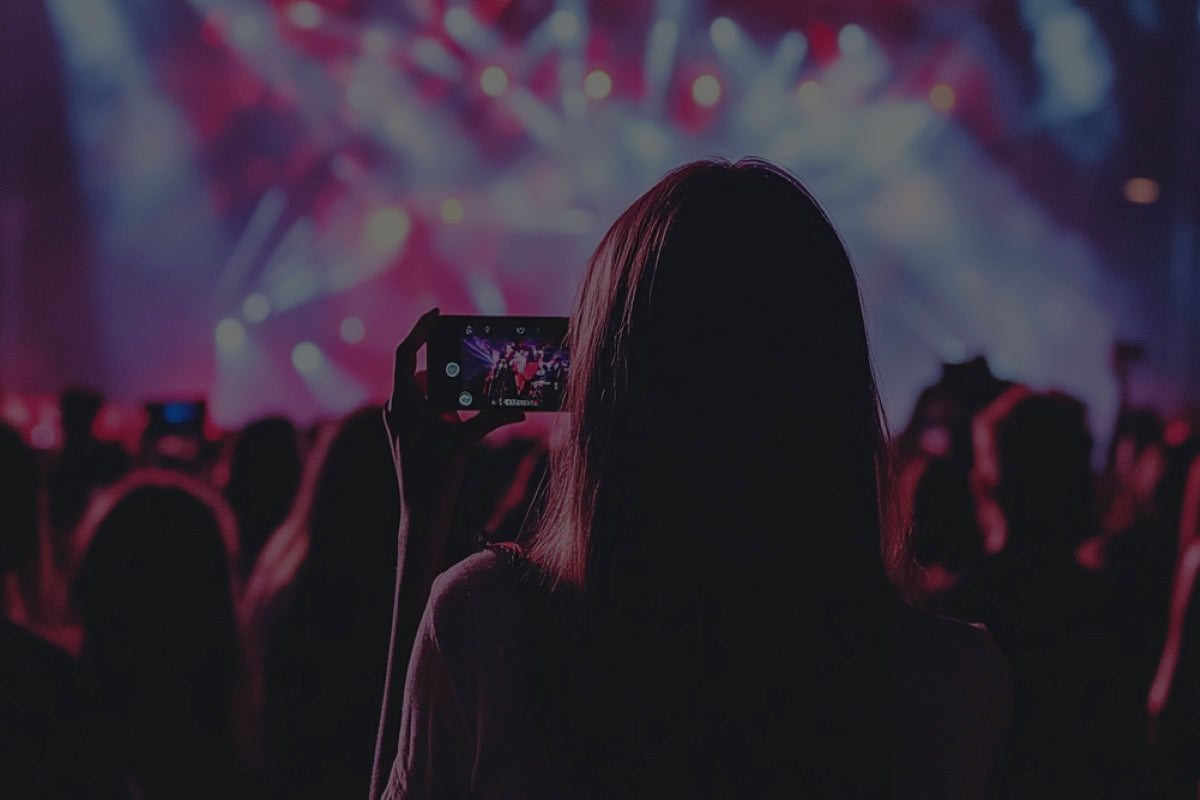
The bass reverberates through your chest. Thousands of voices unite in perfect harmony. That guitar solo you've listened to a hundred times hits differently when you're experiencing it live. In this moment, you think, "I'll remember this forever."
But will you?
The Memory Dilemma
Live music is experiencing unprecedented growth. Live Nation, the world's leading live entertainment company, reported record-breaking attendance of over 145 million fans globally in 2023. More people than ever are seeking out the irreplaceable experience of live music. Yet research shows these precious memories fade faster than we expect.
A landmark study published in Psychological Science found that our memories of emotional events begin losing their vivid detail within days, even when we're convinced we'll remember them forever. This "memory confidence" paradox reveals a crucial truth: the intensity of an experience doesn't guarantee its preservation in our memory. It's a big reason so many people can't remember concerts they attended. The exception is why your first concert still anchors everything — first experiences benefit from a "reminiscence bump" that gives them privileged encoding. (Meanwhile, the people around you are busy being one of 50 concert archetypes, from The Full-Set Recorder to The Silent Rememberer.)
Meanwhile, we're documenting more than ever before. According to Google Photos data, the average user stores over 15,000 photos annually. Yet research published in the Journal of Experimental Psychology reveals a counterintuitive truth: the more we rely on our devices to capture moments, the less our brains engage in the deep processing needed for long-term memory formation.
When Your Phone Works Against You
The science is clear: excessive phone use during live events actually impairs our memory formation. Dr. Linda Henkel's widely-cited research on the "photo-taking impairment effect," published in Psychological Science, demonstrated that people who took photos of objects were less likely to remember the details compared to those who simply observed them.
This effect is particularly pronounced at concerts. Research from the University of California found that participants who extensively documented an experience through photos and videos showed:
- Significantly decreased recall of specific performance details
- Reduced emotional connection to the experience
- Lower satisfaction with the overall event
The implication is stark: phone-free concerts may actually produce stronger memories than phone-heavy ones, precisely because they force the kind of undivided attention that encoding requires.
The Science Behind Stronger Memories
Our brains don't work like smartphones. Memory formation is a complex process that neuroscience has helped us understand better:
Emotional Engagement: Research published in Nature Neuroscience confirms that the amygdala, our emotional processing center, plays a crucial role in memory formation. When we're fully present and emotionally engaged, we create stronger, more lasting memories. This is why emotional peaks encode so strongly — the moments that move us to tears are often the ones we remember most vividly decades later.
Multi-Sensory Processing: A study in the journal Learning & Memory demonstrated that memories involving multiple senses have a significantly higher likelihood of long-term retention. While your phone captures sight and sound, it misses the full sensory experience.
Active Reflection: Research from Harvard Business School's Working Knowledge found that participants who engaged in active reflection about their experiences showed significantly better retention of both details and emotional content compared to those who didn't.
Why Writing Makes the Difference
The physical act of writing has unique cognitive benefits. A 2021 study in Frontiers in Psychology demonstrated that handwriting activates brain regions crucial for learning and memory in ways that digital documentation doesn't match. This is one of the core principles behind concert journaling. This research revealed profound impacts on memory preservation when people document experiences by hand. When writing, they engage more regions of the brain simultaneously, processing information more deeply than digital documentation allows. This deeper engagement creates stronger neural pathways for memory retrieval, while simultaneously establishing more robust emotional connections to the experience. The tactile nature of writing, combined with the slower pace it requires, gives our brains the time needed to form lasting impressions of our experiences.
The Power of Structured Reflection
This is where a dedicated concert journal becomes invaluable. Unlike scattered photos or hasty social media posts, structured documentation guides you through preserving what truly matters. Through intentional documentation, you capture and document the setlist that tells the story of the night, record the friends who shared the experience, and preserve the unexpected moments that made it special. Most importantly, you document the emotions that transformed it from a simple show into a cherished memory.
A journal entry doesn't just capture what happened—it preserves how it felt. Twenty years from now, you won't just remember that you saw your favorite band. You'll remember how the crowd erupted during the surprise encore. You'll recall the exact moment when that new song became your favorite. You'll relive the joy of sharing that perfect musical moment with someone special. Each entry becomes a time capsule, not just of events, but of emotions, sensations, and connections that made each concert unique. (This is also why we cry at concerts — the emotional weight of live music creates the kind of peak experiences that become lifelong memories.)
Finding the Balance
This isn't about abandoning your phone—it's about enhancing your memory preservation strategy. (Apple's Photos app can now recognize your concert photos automatically, but even that clever feature captures the event, not the experience.) Research from the Journal of Applied Research in Memory and Cognition suggests that the most effective memory preservation combines multiple methods:
- Take fewer, more intentional photos
- Stay present for the most impactful moments
- Document experiences within 24 hours while memories are fresh
- Combine visual and written elements to tell the complete story (i.e. concert memories scrapbook page)
The Long View
Consider this: In 20 years, will you scroll through tens of thousands of digital photos to find that one concert moment? Or would you rather open a journal and instantly reconnect with not just what you saw, but what you felt?
Every concert tells a story. Your phone captures fragments, but your journal preserves the narrative. In an age of endless digital content, there's something powerful about having a dedicated space for your concert memories—a tangible record of the moments that moved you, the music that shaped you, and the experiences that defined your life's soundtrack.
Don't just record your concerts. Remember them in a concert journal. For capturing concerts digitally while the details are still fresh, the memory capture feature in the app prompts you with age-aware questions that adapt based on how recently the show happened. Your future self will thank you.
FAQ
Why do I forget concerts I went to?
Your brain doesn't store memories like a hard drive. Concert memories are emotional and sensory, which makes them feel permanent in the moment but actually makes them vulnerable to decay. Without active reinforcement — writing about the experience, revisiting details — the specifics fade within days while you retain only a vague sense that the show happened. The "memory confidence" paradox means the more intense the experience felt, the more surprised you are when you can't recall it later.
Does taking photos at concerts actually hurt your memory?
Research says yes, when it's excessive. Dr. Linda Henkel's "photo-taking impairment effect" shows that photographing something reduces your recall of it. When you're focused on framing and capturing, your brain offloads the memory work to the device. A few intentional photos don't cause problems. Filming entire songs does.
Why does writing help you remember concerts better than photos?
Writing engages deeper cognitive processing than snapping a photo. You have to choose what to include, put sensory experience into words, and make meaning out of what happened. A 2021 study in Frontiers in Psychology showed that handwriting activates brain regions tied to learning and memory that digital documentation doesn't. You're not just recording — you're encoding.
How soon after a concert should I write about it?
Within 24 hours, ideally. Memory research consistently shows that detail loss accelerates after the first day. The car ride home or the morning after are the sweet spots — you're still buzzing but can think clearly enough to capture specifics. Waiting a week means you'll remember the headline but lose the texture.
Is a concert journal better than a notes app for memory?
For memory formation, yes. The physical act of handwriting creates stronger neural pathways than typing. You also process more slowly, which forces your brain to prioritize and engage with the details rather than transcribing them. A notes app is better than nothing, but a dedicated journal with structured prompts pulls more out of you than a blank screen.
Can music trigger memories even if I didn't write anything down?
Absolutely. Music is one of the strongest memory cues we have, processed through brain regions tied to emotion and autobiographical memory. Hearing a song from a show can bring back feelings and fragments of the experience. But those fragments are incomplete. You'll remember the emotional tone without the specifics — who you were with, what the venue looked like, what happened during the encore. Writing fills in what music alone can't recover.
What's the most important thing to document after a concert?
The details that won't survive on their own: who you went with, where you stood, what surprised you, how the crowd reacted, what you felt during specific songs. The setlist and venue are recoverable from the internet. Your personal experience is not. That's what disappears first and matters most when you revisit the memory later.
Does this science apply to festivals or just single concerts?
It applies to both, and arguably more to festivals. Multi-day events create a blur effect where individual sets, days, and moments merge together. The sheer volume of experiences overwhelms your brain's ability to encode them distinctly. Documenting at the end of each day is critical for festivals — otherwise you'll remember the weekend as one undifferentiated block rather than a sequence of specific moments. We wrote a full breakdown of why festivals blur together and what you can do about it.
Sources
- Live Nation Entertainment. (2024). Live Nation Entertainment Reports Fourth Quarter & Full Year 2023 Results. [Live Nation Reports Record Year With Revenue Up 36%, Operating Income Up 45%, AOI Up 32%]
- Henkel, L. A. (2014). Point-and-shoot memories: The influence of taking photos on memory for a museum tour. Psychological Science, 25(2), 396-402. [Research on photo-taking impairment effect]
- Smoker, T. J., Murphy, C. E., & Rockwell, A. K. (2009). Comparing memory for handwriting versus typing. Proceedings of the Human Factors and Ergonomics Society Annual Meeting, 53(22), 1744-1747. [Research on handwriting vs. digital memory retention]
- Mueller, P. A., & Oppenheimer, D. M. (2014). The pen is mightier than the keyboard: Advantages of longhand over laptop note taking. Psychological Science, 25(6), 1159-1168. [Study on handwriting's cognitive benefits]
- Tamir, D. I., Templeton, E. M., Ward, A. F., & Zaki, J. (2018). Media usage diminishes memory for experiences. Journal of Experimental Social Psychology, 76, 161-168. [Research on media usage impact on experience memory]
- Di Vesta, F. J., & Gray, G. S. (1972). Listening and note taking. Journal of Educational Psychology, 63(1), 8-14. [Classic study on information retention methods]
- Craik, F. I., & Lockhart, R. S. (1972). Levels of processing: A framework for memory research. Journal of Verbal Learning and Verbal Behavior, 11(6), 671-684. [Foundational research on memory processing]
Share: