

You've been to dozens of concerts. Maybe over a hundred. You remember attending most of them. But when someone asks what song opened that incredible show three years ago, or who you went with to see your favorite band the second time, or what the venue even looked like, you draw a blank.
This isn't a memory problem. It's a documentation problem. And concert journaling solves it. (New to the concept? Start with what is a concert journal for the basics.)

Why Concert Memories Fade Faster Than You Expect
The details that make concerts special are the first things to disappear. Research on episodic memory shows we lose specifics within days of an experience, retaining only the general impression. You'll remember that you saw a band, but not how it felt when they played the deep cut you'd waited years to hear live.
Within a week, you've lost the opener's name. Within a month, the setlist is a blur. Within a year, that show you swore you'd never forget has merged with every other concert into a vague sense of "yeah, I've seen them."
The more concerts you attend, the worse this gets. Your 47th show doesn't stand out the way your 7th did. They start blending together. Unless you write something down.
The 24-Hour Rule
Document your concerts within 24 hours of the show ending. Not three days later. Not "when you have time." Within 24 hours.
Here's why this window matters:
Your brain consolidates memories during sleep. The night after a concert, you still have access to details that will be gone by the next sleep cycle. The name of the song that made everyone around you lose their minds. The moment the lead singer said something that made the crowd roar. The friend who almost didn't come but ended up having the best time.
Miss that window, and you're writing from a much hazier version of the experience.
The best time to document is the car ride home (if you're not driving), the next morning with coffee, or during the post-show buzz before you go to sleep. Pick whatever works for your life. Just don't let 24 hours pass without capturing something.
What to Actually Write Down
Concert journaling captures two categories: facts and feelings. Both matter for different reasons.
Facts (What Happened)
Facts anchor your memory in specifics. They're the details that jog everything else loose when you revisit your entry years later.
- Date and day of week
- Artist or band name
- Venue and city
- Who you went with
- Your spot (section, seat, or where you stood)
- The setlist (or at least the songs you remember)
- Openers
- How much you spent on tickets
- What merch you bought (or almost bought)
Facts feel mundane to write, but they're irreplaceable later. "Friday, March 15, 2024 at Red Rocks with Sarah" brings back more than "that time at Red Rocks."
Feelings (How It Felt)
Feelings are why concerts matter. They're also what fades fastest.
- Your emotional state going into the show
- The moment that hit hardest
- How the crowd felt around you
- What surprised you (good or bad)
- How you felt walking to the car afterward
- Whether you'd see them again
- One word to describe the night
Don't overthink the feelings section. You're not writing poetry. You're leaving breadcrumbs for your future self.
"That acoustic moment when the whole arena went silent and you could hear people crying around me" is more valuable than any photo you took.
Quick-Log vs. Deep-Dive: Two Approaches That Work
Not every concert needs three paragraphs. But every concert deserves something.
Quick-Log (1-2 minutes)
For routine shows, the openers you caught before the headliner, the festival sets that blurred together:
- Artist, date, venue, who you went with
- One sentence about the highlight
- A rating if you use them
Quick entries stack up. Fifty quick-logs give you a searchable concert history. That alone is valuable.
Deep-Dive (10-15 minutes)
For the shows that mattered. The bucket list artist. The surprise show that became your favorite of the year. The concert where something shifted.
- Full setlist with notes on standouts
- Multiple memory prompts answered
- What you wore, ate, drank
- Pre-show and post-show feelings
- Photos or memorabilia attached
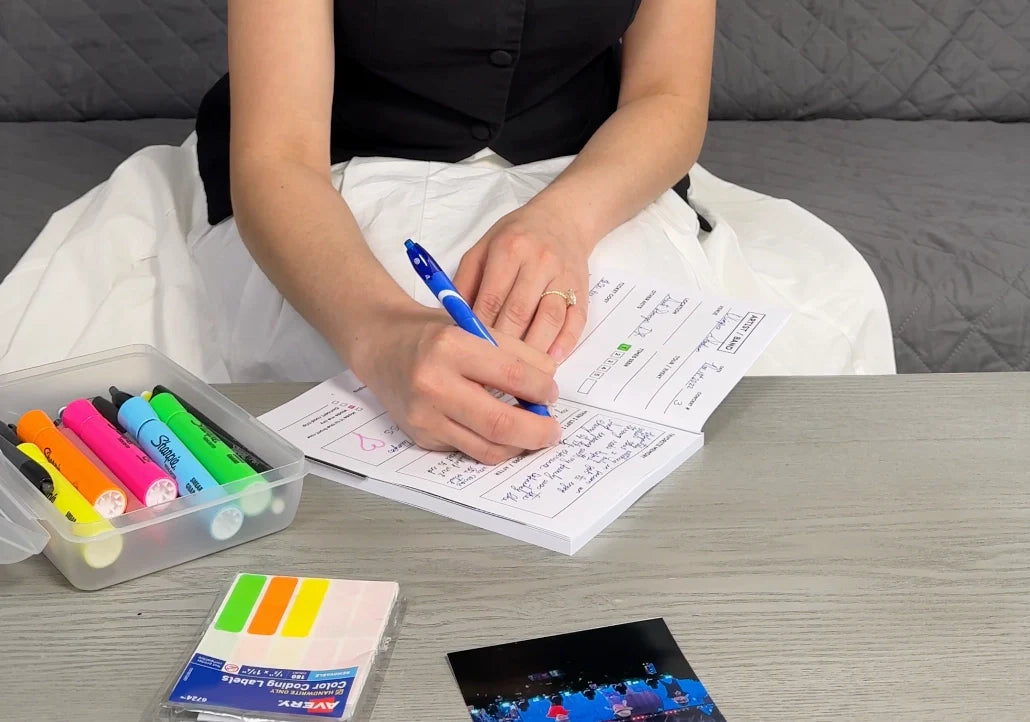
The Concerts Remembered journal uses this approach by dedicating 4 pages per concert: details, ratings, setlist, and a blank page for ticket stubs and photos. See What to Write in a Concert Journal for specific prompts, or browse our full list of concert journal prompts for more ideas.
The key insight: consistency beats depth. A quick note for every show builds something. Occasional detailed entries for "special" shows means you skip the rest. For shows that really hit, try these deep concert journal prompts designed for experiences that don't fit neatly into fields and ratings.
Quick-log everything. Deep-dive on the ones that deserve it.
Physical Journal vs. App vs. Everything Else
There are really three options for concert documentation, and they serve different purposes.
Paper Journals
Paper wins for reflection and artifact value. Writing by hand slows you down. The finished journal sits on your shelf for years. Ticket stubs tuck into pockets. It doesn't compete with notifications for your attention.
The Concerts Remembered Classic Journal gives you prompts, ratings, and memorabilia storage in one place, 30 concerts per book. Not sure which format is right for you? See our guide to choosing the right concert journal format.
Best for: People who want a tangible archive, enjoy the ritual of writing, and value having physical memorabilia in one place.

Concert Tracking Apps
Apps win for convenience and stats. The Concerts Remembered app lets you log a show in 30 seconds on your phone. Add photos, ratings, and setlists when you have time. It tracks patterns you'd never notice manually: your most-seen artist, average time between shows, whether you rate concerts generously or critically.
Best for: People who want something always with them, care about stats and searchability, or are catching up on years of past shows.
Spreadsheets and Notes Apps
Spreadsheets work for data-focused people who want total control. Notes apps work if you actually use them. Most people don't. Scattered notes across Apple Notes, Google Docs, and random text files are where concert memories go to die. For a detailed comparison, see concert tracker app vs. spreadsheet vs. journal.
If you're already maintaining a spreadsheet religiously, keep going. If you've tried notes apps and have three years of concerts with no documentation, you need something with more structure.
The "Both" Approach
Many serious concert-goers use both: the app for quick logging and stats, the journal for shows that deserve deeper reflection. They're complementary, not competing.
Quick-log every show in the app. Write a full journal entry for the 3-5 concerts per year that really hit.
Building the Habit
The difference between people who document concerts and people who mean to is just habit architecture. Here's what works:
1. Make It Easy
Keep your journal in your concert bag. Have the app on your home screen. Remove friction between "I should write something" and actually writing.
2. Attach It to Something You Already Do
Document during the post-show meal. Write in the Uber home. Fill in the entry with your morning coffee the next day. Attaching journaling to an existing routine makes it stick.
3. Start Small
One sentence counts. "Incredible show, highlight was the encore, would definitely see again" is infinitely more valuable than nothing. You can always add more later. You can't recreate details you never captured.
4. Accept Imperfection
Your entries don't need to be complete or eloquent. Crossed-out words are fine. Blank fields are fine. Messy handwriting from a post-show buzz is fine. The goal is capturing enough to bring the memory back, not creating a perfect archive.
5. Use the 24-Hour Rule
We covered this earlier, but it's worth repeating. The constraint itself creates urgency. "I have to write something today" beats "I'll get to it eventually" every time.
What If You Have Years of Past Shows to Document?
Two approaches:
Method 1: The Brain Dump
Write down every show you can remember in one sitting. Don't worry about dates or order. Just get them out of your head. Then use setlist.fm, old photos, email receipts, and bank statements to fill in details. See How to Find Your Concert History for specific techniques.
This method works well in the app, where you can quickly log past shows and add details later.
Method 2: The Snapshot Approach
For truly long histories (100+ shows), use a quick-log format just to get them recorded. The Snapshot Journal holds 100 concerts with one page each. It's not for deep journaling. It's for getting shows on record.
Accept that past concerts won't have the same detail as future ones. That's fine. Having a list with basic details is better than having nothing.
Common Mistakes to Avoid
Waiting for "free time": Free time doesn't exist. If you don't document within 24 hours, you probably won't document at all.
Trying to write everything: You'll burn out. Quick entries for most shows, detailed entries for special ones.
Relying on photos alone: Photos capture what something looked like. They don't capture how you felt, who you were with, or why it mattered. Photos and writing together work better than either alone.
Being too precious: Don't wait until you have the perfect setup or the right notebook or a quiet moment. Write something messy now rather than something perfect never.
Skipping the "small" shows: The random Tuesday night club show might become the memory you treasure most. You won't know which shows matter until years later. Document all of them.
FAQ
How do I start a concert journal if I've never journaled before?
Start with your next show. Write down artist, date, venue, who you went with, and one thing you want to remember. That's it. You can expand from there, but those five details are enough to anchor the memory. Don't pressure yourself to write paragraphs. Even a few lines per show builds into something meaningful over time.
Should I write in my concert journal during the show or after?
After. Always after. During the show, be present. Take a few photos if you want. Maybe jot the setlist in your phone if you're tracking song order. But the real documentation happens later, when you're still buzzing but the lights are up. The car ride home or the morning after are ideal.
What if I can't remember the setlist?
Check setlist.fm. Fans post setlists within hours of most shows. Copy it into your journal and add notes about which songs hit hardest, any surprises, or moments between songs that stood out. For smaller shows that aren't on setlist.fm, write what you remember. A partial list is better than no list. See our guide on how to find the setlist for any concert for more methods.
Is a paper concert journal better than an app?
Different tools for different purposes. Paper journals become artifacts you keep forever. They don't need charging. Ticket stubs fit in the pockets. But apps are always with you, track stats automatically, and make catching up on past shows easier. Many people use both: app for quick logging, journal for shows that deserve deeper reflection. For a detailed breakdown, see app vs. physical journal: which is right for you.
How much should I write for each concert?
As much or as little as you want. One sentence is better than nothing. Three pages is fine if you're inspired. Most people land somewhere in between: a few key details plus one or two emotional highlights. The prompts in the Concerts Remembered journal guide you through ratings, memories, and setlist without requiring essays.
What if I have years of past concerts I never documented?
Start with a brain dump of every show you remember, then use photos, email receipts, and setlist.fm to fill in details. For very long histories, consider a quick-log format first (just getting shows on record) before going back to add depth. The app works well for catching up since you can log past dates quickly.
Do I need to document every concert I attend?
You don't need to do anything. But the concerts you think don't matter are often the ones you wish you'd documented later. Quick-log everything, even if it's just artist, date, and venue. Spend more time on the shows that really hit. Consistency matters more than completeness.
How do I make concert journaling a habit?
Attach it to something you already do: the post-show meal, the ride home, your morning coffee. Use the 24-hour rule as a constraint. Start with one sentence if that's all you have energy for. Keep the journal somewhere visible. Make it easier to write than not to.
Start Documenting Your Concert History
The concerts you attend this year will blur into vague memories by next year. Unless you write something down.
The Concerts Remembered Journal gives you prompts for every entry, space for setlists, ratings for sound and performance, and pockets for ticket stubs. It does the thinking so you can focus on capturing what happened.
→ Shop the Concert Journal Collection
The Concerts Remembered App lets you log shows in 30 seconds and tracks your concert history with stats, milestones, and shareable cards.
→ Download the Concert Tracking App
Share: