

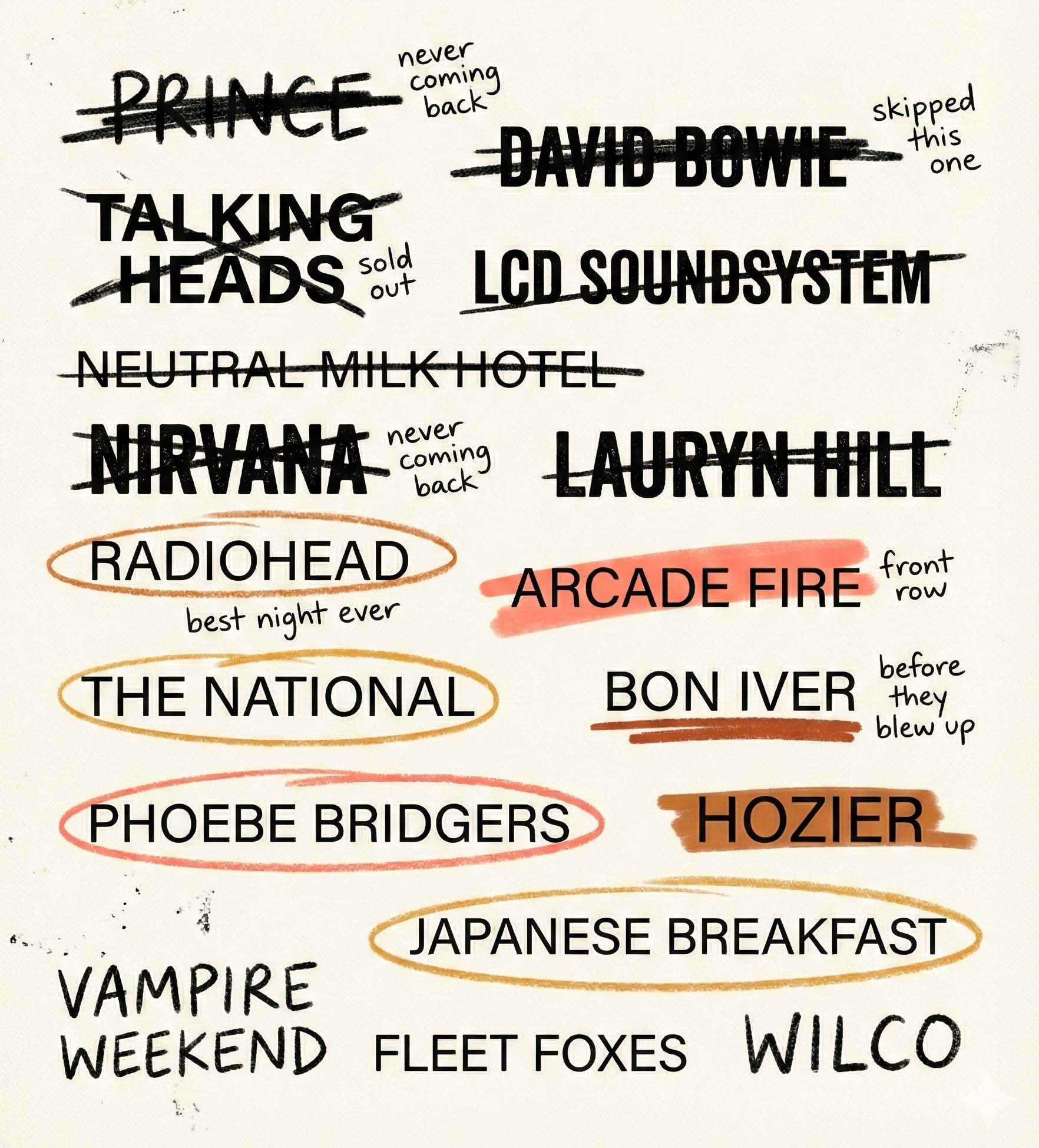
Everyone who loves live music has a list they don't talk about.
Not the list of shows they've seen. The other one. The shows they didn't see. The ones they skipped, couldn't afford, didn't know about, or just... didn't go to for reasons that made sense at the time.
And on the flip side: the shows they caught before anyone else was paying attention. The "I saw them when" stories that feel like bragging but also feel earned.
These two lists, the misses and the early catches, are the shadow history of your concert life. And they stay with you longer than you'd expect. There's actual science behind why concert memories stick with us so deeply.
The Show You Missed
Let's start with the painful one.
There's a specific kind of regret that only comes from missing a concert you could have attended. Not "couldn't afford it" or "lived too far away." The ones where you had the chance and didn't take it.
Maybe tickets were available and you hesitated. Maybe a friend invited you and you said no. Maybe you just didn't feel like going out that night.
And then sometimes years later you realize what you missed.
The Legends You'll Never See
Some artists are gone now. Actually gone.
Prince. David Bowie. Tom Petty. Chris Cornell. Taylor Hawkins. Aretha Franklin. Leonard Cohen. Phife Dawg. MF DOOM.
If you had a chance to see any of them and didn't take it, you know exactly what I'm talking about. That window closed permanently. No reunion tour. No "maybe next time." Just: that was it, and you weren't there.
This isn't about guilt. You couldn't have known. Nobody books concert tickets thinking "this might be my only chance ever." But the regret still finds you.
The Tours That Never Came Back
Death isn't the only way a show becomes unmissable.
Some artists just stop touring. Retirement, health issues, creative differences, the economics of live music. There are a hundred reasons an artist might never come back to your city, or never tour again at all.
Kate Bush hadn't performed live in 35 years before her 2014 residency. If you didn't catch that, you probably never will.
Lauryn Hill tours sporadically and unpredictably. LCD Soundsystem broke up, came back, might disappear again. Fiona Apple barely tours at all.
The "I'll catch them next time" logic assumes there will be a next time. Sometimes there isn't.
The One Where You Just Didn't Go
This is the one that really stings.
Not the legend who passed away. Not the artist who stopped touring. Just a regular show, on a regular night, that you decided to skip.
You were tired. You had work the next day. You'd seen them before. Tickets were kind of expensive. You figured you'd go next time.
And then next time came and it was sold out. Or the venue was bigger and worse. Or the setlist wasn't as good. Or they never came back.
The show you skipped isn't always the show you'd expect to regret. Sometimes it's a random Tuesday that turned out to be the night everyone still talks about.

The Show You Caught Early
Now the other side. The good list.
There's a specific kind of satisfaction that comes from seeing an artist before they broke. Not because it makes you special, but because it means you were paying attention. You followed your curiosity. You took a chance on something unproven.
And then, later, when everyone else discovers them, you have this private knowledge: I was there when.
The Opener Who Blew Up
This is the most common version.
You went to see the headliner. You showed up early enough to catch the opener. You didn't know who they were. And then, two years later, they're selling out arenas.
Some examples people bring up constantly: Hozier opening for Annie Lennox. Billie Eilish opening for Florence and the Machine. The 1975 opening for Muse.
The numbers back this up. Sabrina Carpenter went from 25 million to 80 million Spotify listeners after opening 25 Eras Tour dates. Gracie Abrams grew from 5 million to over 30 million. The opener you almost skipped might be the headliner you'll pay $200 to see next year (LSU Media).
If you caught any of those, you have a story. Not a brag, just a story about a night when you accidentally witnessed something before it became a thing.
The Small Venue Before the Big Rooms
This is the version that feels most earned.
You heard about an artist early. You bought tickets to a 200-cap room. You stood ten feet from the stage. And then, within a year or two, they were playing theaters, then arenas, then stadiums.
The intimacy of that early show becomes irreplaceable. You can never see them in a room that small again. The thing you witnessed doesn't exist anymore, not because the artist is gone, but because the context is gone.
Seeing an artist in a club before they graduate to arenas is its own kind of time travel. You were there for a version of them that nobody else can access.
The Legacy Artist While They Still Had It
The inverse of "I missed the legend" is "I caught the legend."
Seeing Prince in 2015. Catching Bowie on the Reality tour. Being at a Tom Petty show in his final year without knowing it was the final year.
These don't feel like bragging because they're bittersweet. You didn't know it was special at the time. You just went to a show. It became special in retrospect, after the window closed for everyone else.
Why These Lists Matter
Here's the thing about concert regret and concert pride: they're both about paying attention.
The shows you missed often come down to hesitation. Waiting too long. Assuming there'd be another chance. Not trusting your instinct that said "you should go to this."
The shows you caught early come down to the opposite. Acting on curiosity. Taking chances on unknowns. Saying yes to things that weren't sure bets.
Over time, these two lists teach you something about yourself. They teach you how you make decisions, and whether those decisions are serving you.
The people with the fewest regrets aren't the ones who go to everything. They're the ones who learned to recognize the shows that matter and act on that recognition.
The Uncomfortable Truth About "Next Time"
There might not be a next time.
That's not pessimism. It's just true. Artists stop touring. Venues close. Lineups change. People die, including, eventually, you.
Every show is a one-time configuration. This artist, this setlist, this venue, this crowd, this night. Even if you see the same artist again, it won't be the same show.
The math of "I'll go next time" is almost always wrong. The conditions that exist tonight won't exist again. The only show you're guaranteed access to is the one that's on sale now.
And ticket prices aren't getting cheaper. The average top-100 tour ticket hit $135.92 in 2024—up 41% from 2019 (Pollstar). The show you're hesitating on today will cost more next time, if there is a next time.
This sounds heavy. It's not meant to be. It's actually the opposite. It's freedom.
When you stop assuming there's always a next time, you start making better decisions about this time.
What To Do With This
I'm not saying go to every show. That's not realistic, and it's not even desirable. Part of what makes concerts meaningful is that you can't see everything. Scarcity is part of the value.
But I am saying: pay attention to the ones that feel like they might matter. And if you're trying to piece together shows you've already been to, here's how to find your concert history.
The artist you've been meaning to see for years? Go.
The legacy act that's still touring but won't be forever? Go.
The opener you've never heard of but have a good feeling about? Stay for their set.
The random weeknight show that you're on the fence about? More often than not, go.
Your future self is building one of two lists right now. You get to decide which one grows.
And whichever shows you do go to, writing something down afterward is the simplest way to make sure they don't end up on a third list: the shows you went to but can't remember. That's its own kind of regret, and there's a real reason so many people can't recall concerts they attended.
What's your biggest concert miss, the one that still stings? And what's your best "I saw them when" story? We want to hear both lists.
Start Building Your Lists
The memory capture feature in the Concerts Remembered app helps you capture every show you attend, so future-you has the complete record, not just the highlights you happen to remember.
Frequently Asked Questions
Is it normal to feel regret about missing a concert?
Completely. Concert regret is one of the most common feelings among live music fans, and it hits harder than most other types of FOMO because shows are unrepeatable. Even if you see the same artist again, it won't be the same setlist, same venue, same crowd, same night. The specific configuration of that show is gone. That's why the "I'll go next time" logic fails so often.
How do I stop missing concerts I'll regret?
There's no formula, but the pattern is consistent: the shows people regret missing most are the ones where they hesitated. Legacy artists still touring, small venue shows before an artist blows up, and the random weeknight gig they were on the fence about. If you find yourself thinking "I should probably go to that," you probably should. The ticket price stings for a week. The regret lasts years.
What's the difference between concert regret and concert FOMO?
FOMO is about a show happening right now that you're missing. Concert regret is longer-term. It's the show from 2016 that you could have attended and didn't, and now the artist has retired, or passed away, or never toured your city again. FOMO fades by the next morning. Regret compounds over time, especially when you realize the window closed permanently.
Why do people brag about seeing artists before they were famous?
It's less about bragging and more about the irreplaceability of the experience. Seeing an artist in a 200-person room before they're filling arenas is a version of that artist that no longer exists. You can't buy tickets to that show anymore. The intimacy, the energy, the scale of it is gone forever. People share those stories because the experience was genuinely unique, not because they want credit for good taste.
How do I figure out which shows I've actually been to?
Most people can recall the major ones but forget a surprising number of smaller shows. Start with email confirmations from Ticketmaster, AXS, and StubHub. Check your camera roll sorted by date. Look at old social media posts. Ask friends who went with you. Setlist.fm's tour history pages can confirm dates and venues. For a complete walkthrough, how to find your concert history covers every method.
Should I keep a list of concerts I've missed?
Some people do, and find it useful as a reminder to act on future opportunities instead of hesitating. Others find it depressing. Either way, keeping a list of concerts you've attended is more productive. When you can see your full history in one place, you notice patterns in how you make decisions about shows, which helps you make better ones going forward.
Share: