

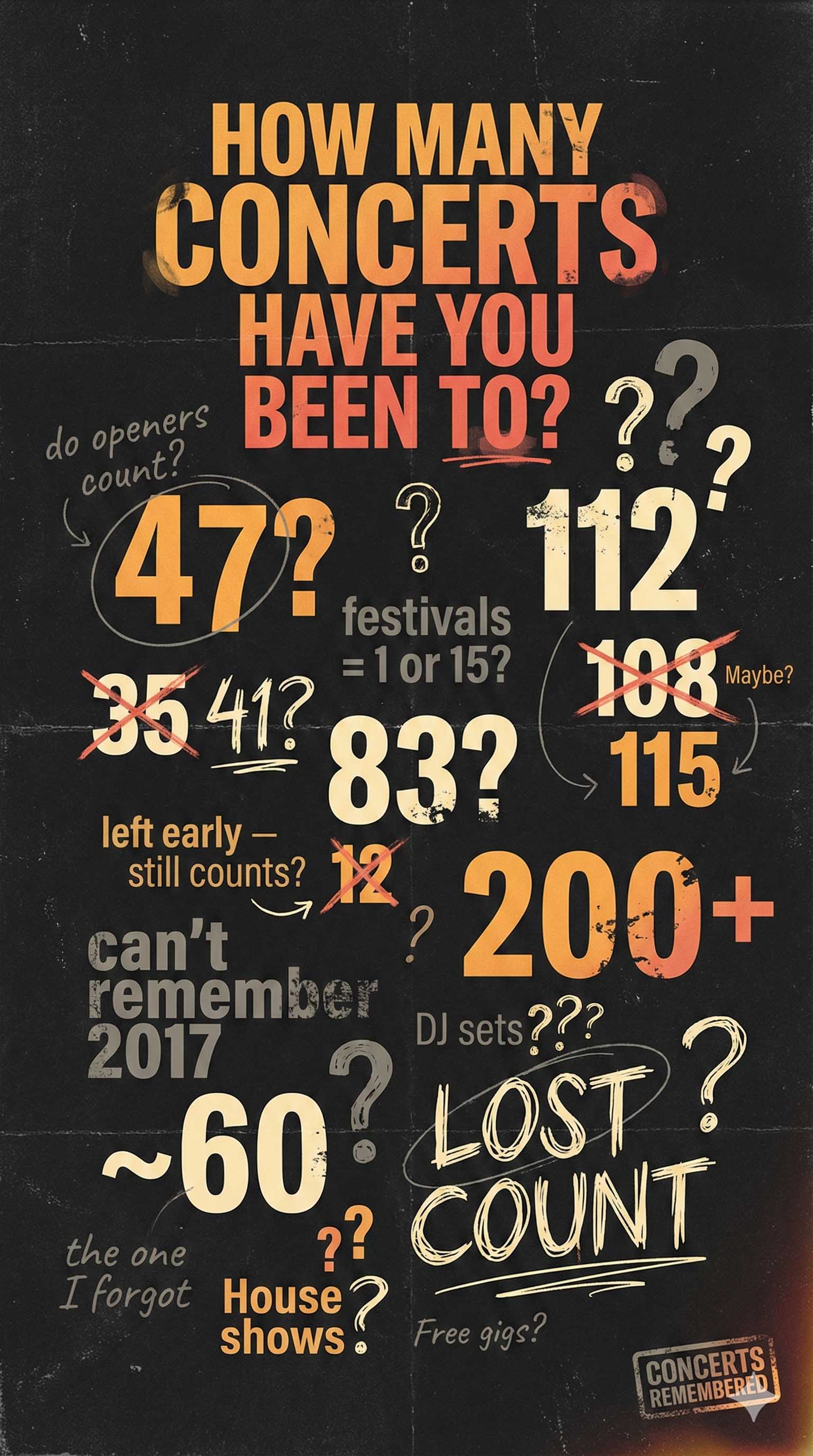
At some point, someone asks. Maybe it's a new friend, maybe it's a dating app prompt, maybe it's just your own brain at 2am. The question sounds simple:
"How many concerts have you been to?"
And then you realize you have no idea.
You could guess. You could say "a lot" and leave it vague. Or you could try to actually count, and that's when the problems start.
The Number Feels Like It Should Be Easy
You'd think this would be straightforward. You were either at a show or you weren't. It's binary. Countable.
Except it isn't.
Because almost immediately, you run into questions that don't have obvious answers. And the more shows you've been to, the messier it gets.
What counts as "a concert"? What about the shows you barely remember? The ones you left early? The ones where you were technically present but not really paying attention?
Everyone has a number in their head. Almost nobody has actually done the math. And if you have done the math, you've made a dozen judgment calls along the way, whether you realized it or not.

The Debates That Make Counting Messy
This is where it gets fun. Or frustrating. Depending on how much you care about accuracy.
Do Openers Count as Separate Concerts?
If you went to see the headliner and stayed for the whole night, did you see one concert or three?
Most people count the full evening as one show. But what if the opener was someone you specifically wanted to see? What if you discovered your new favorite artist in that opening slot?
There's no right answer. Just know that this single question can swing your lifetime count by dozens.
What About Festivals?
Festivals break everything.
A single weekend at a festival might include 15 different artists across multiple stages. Do you count that as one concert? Fifteen concerts? Somewhere in between?
The honest approach: count the sets you actually watched. Not walked by. Not heard from the beer line. Actually stood there and experienced.
But almost nobody tracks it that way, because who's taking notes during a festival?
Does a Partial Show Count?
You got there late. Or you left early. Or you were there for the whole thing but spent half of it trying to find your friends.
Is that a concert?
Most people say yes. You were there, it counts. But there's a spectrum. Catching three songs before you had to leave feels different than staying for the encore.
DJ Sets, Comedy Shows, and the Genre Question
Some people count strictly: concerts mean live music with instruments. Others include DJ sets, stand-up comedy, spoken word, theater, anything with a stage and a ticket.
There's no universal rule here. Just be consistent with yourself.
The "I Don't Remember" Problem
Here's the real issue: most people can't actually remember every show they've been to.
The big ones stick. The first concert. The bucket-list artist. The night that changed everything. But that random Tuesday show five years ago? The opener whose name you never learned? The festival set you watched half-asleep?
Gone. Or at least, gone until something jogs your memory.
Your actual concert count is almost certainly higher than the number you can recall. Which means any count you come up with is a floor, not a ceiling. If you want to start piecing together shows you've forgotten, here's how to find your concert history.
Why People Get Weird About Their Number
Here's something nobody talks about: concert counts feel strangely personal.
A high number can feel like a badge of honor. Proof that you prioritize experiences. Evidence that you've really lived.
A low number can feel like you need to explain yourself. "I just got into live music recently." "I don't live near good venues." "I had kids young."
Neither reaction makes sense if you think about it. Someone who's been to 200 concerts hasn't necessarily had better experiences than someone who's been to 20. A perfect show is a perfect show regardless of what number it is in your sequence.
But the number still feels like it means something. It's a proxy for identity, the story you tell yourself about what kind of person you are.
The Average Is Lower Than You Think
If you're someone who goes to a lot of shows, you probably assume everyone else does too. They don't.
Most adults go to maybe one or two concerts a year. Many go years without seeing any live music at all. If you're at 50 lifetime concerts, you're already well above average. At 100, you're in a small minority. At 200+, you're basically a different species.
This isn't gatekeeping. It's just context. If you're wondering whether your number is "good," it probably is. For a deeper breakdown of where you fall on the spectrum, we looked at how many concerts the average person attends per year and the numbers might surprise you.
How People Actually Track This
Most people don't. That's the honest answer.
They have a rough sense. They remember the highlights. They couldn't give you a list if you asked.
The people who do track it usually fall into a few camps:
The spreadsheet people. They've got a Google Sheet going back years. Artist, date, venue, maybe some notes. It works, but it's manual and requires discipline.
The ticket stub collectors. Old school. Physical proof of every show, stuffed in a shoebox or pinned to a board. Except now that tickets are digital, this system is dying.
The app trackers. Setlist.fm, Last.fm, and dedicated concert tracker apps that log show attendance. Some are designed more for setlist data than personal memory, so the right tool depends on whether you want a list or a record.
The social media archive divers. Every few years, they scroll back through Instagram or Facebook looking for concert posts. It's tedious and incomplete, but it surfaces things they'd forgotten.
None of these methods are great on their own. They're all either high-effort, incomplete, or both. Which means most people just... don't know their number.
What Your Number Actually Tells You
Here's what I've realized: the number itself is the least interesting part.
What's actually interesting is the texture underneath it. The patterns you don't notice until you write it all down.
Like: How many artists have you seen more than once? What's your most-visited venue? Is there a year you went to way more shows than usual, and do you remember why? Are there artists you saw before they got big? Are there legends you caught before they were gone?
The number is a door. What's behind it is the actual story.
That's part of why we built Concerts Remembered. Not just to help you arrive at a count, but to see what that count actually contains. When all your shows are in one place, you stop guessing and start noticing. The number becomes real, and so do the patterns you never saw before.
So... How Many Concerts Have You Been To?
You probably still don't know exactly.
And honestly, that's fine. The goal isn't to arrive at a perfect number. It's to have a better sense of your own history than "a lot" or "I don't know."
Start writing them down. You'll remember more than you expect. You'll forget more than you'd like. And somewhere in the middle, you'll land on a number that feels true, even if it's not perfectly accurate.
That's your number. It doesn't have to match anyone else's rules.
It just has to be yours.
What's your current count, or your best guess? And what's the weirdest judgment call you've had to make about whether something "counts"? We want to hear the edge cases.
Frequently Asked Questions
How many concerts has the average person been to?
Most adults attend one or two concerts per year, and many go years without seeing live music at all. Over a lifetime, someone who goes to a few shows a year might hit 50-80 total. If you're at 100+, you're well above average. At 200+, you're in a very small group. For a full breakdown by fan type, how many concerts the average person attends per year covers the spectrum from casual listeners to superfans.
Do openers count toward my concert count?
There's no universal rule. Most people count the full evening as one show, regardless of how many artists played. But if you specifically went to see an opener, or if you discovered a favorite artist in that opening slot, some people count them separately. The key is being consistent with whatever system you choose. Just know that this single question can swing your lifetime count by dozens.
How do I count festival concerts?
The honest approach: count the sets you actually watched. If you stood in the crowd for a full set at a dedicated stage, that counts. If you heard three songs while walking between stages, it doesn't. A three-day festival could be 1 event or 12 individual sets depending on your method. Most people pick one rule and stick with it.
Why can't I remember all the concerts I've been to?
Your brain consolidates similar experiences and drops details that don't have external anchors (like a ticket stub or journal entry). The big shows stick, but smaller shows fade. Your actual count is almost certainly higher than what you can recall off the top of your head. Digging through email confirmations, your camera roll, and friends' memories usually surfaces shows you'd completely forgotten about.
What's the best way to count concerts I've been to?
Start with what you remember and write it down. Then systematically check: email confirmations from Ticketmaster, AXS, and StubHub; your camera roll sorted by date; old social media posts; bank and credit card statements for venue charges; and setlist.fm's tour history pages. Ask friends who went to shows with you. Our guide on how to find your concert history walks through every method.
Is there an app that counts how many concerts I've been to?
Yes. Setlist.fm lets you mark "I was there" on shows to build a count. The Concerts Remembered app logs shows and automatically tracks stats including your total count, most-seen artists, most-visited venues, and attendance patterns over time. You can also add past shows, not just new ones.
Does it matter how many concerts you've been to?
Not in the way people usually think. Someone who's been to 20 incredible shows has a richer concert life than someone who's been to 200 forgettable ones. The number is interesting as a starting point, but the real value is in the patterns underneath it: who you've seen, where you've been, how your habits have changed over time, and which shows actually mattered to you.
Share: