

Nobody starts tracking concerts because they're thinking about what the data will look like in a decade. You start because you went to a great show and wanted to remember it. Or because you realized you couldn't name half the concerts you'd been to last year. Or because someone gave you a journal and you figured you'd try it.
The first few entries feel like a list. Artist, date, venue. Maybe a rating. Maybe a note about who you went with. It's useful in a small way. You can look back at last month and remember what you saw.
Then a year passes. Two years. Five. And something shifts.
The list stops being a list. It starts being a map of your life told through the shows you attended. And the things it reveals are not the things you expected.
Year One Is Just Data
In the first year, you're building a habit. You log shows. Maybe you write a few sentences about the good ones. You start noticing small things, like how many concerts you actually go to (the answer is usually higher or lower than you guessed) and which venues you keep ending up at.
This is useful but not transformative. It's a record. You can look back at a Tuesday in March and remember, oh right, that's the night we saw that band at the small room downtown. Without the entry, that Tuesday is gone. With it, the night comes back.
If you average one show a month, you have 12 entries after year one. Enough to see what you did. Not enough to see who you are.
Year Three Is Where Patterns Start
Somewhere around 30 to 40 logged concerts, the data starts talking.
You notice that your busiest concert month is always October. You didn't plan that. It just kept happening, year after year, because that's when the fall tours roll through and the weather is good for outdoor venues.
You notice you've seen one artist four times. You knew you liked them, but you didn't realize you'd committed four separate nights and four separate ticket purchases to them across three different cities. That's not casual fandom. That's something deeper.
You notice there's a venue that keeps showing up. Not the big amphitheater everyone talks about. The 500-capacity room across town with the sticky floors and the sound that's too loud in the back left corner. You've been there 9 times in three years. It's your spot, and you didn't know it until you saw it on the page.
These aren't insights you'd ever arrive at from memory alone. They only exist because you wrote things down.
Year Five Is When It Gets Personal
By 50 to 70 concerts, something else emerges. The log stops reflecting your taste in music and starts reflecting your life.
There's a year where you went to 22 shows. You remember why. You'd just moved to a new city, didn't know anyone yet, and live music was the thing that got you out of your apartment. Those 22 shows aren't just concerts. They're the year you rebuilt your social life one venue at a time.
There's another year with only 3 entries. You know why too. New job. New baby. A stretch where going out felt impossible. Looking at those three entries now, you remember each one vividly because they were rare. The one show you made it to that summer was the best night you had in months.
Your concert companion data starts telling stories. One friend appears in 15 entries across four years, then disappears entirely. Another friend shows up for the first time in year three and becomes your most frequent concert partner by year five. Friendships measured not in texts or dinners but in shows attended together.
The science behind why concert memories fade explains why this kind of documentation matters. Your brain doesn't hold onto the details you think it will. But a log with dates, names, and even a sentence of context brings entire chapters of your life back into focus.
Year Seven Is When You See Eras
This is the part nobody talks about, because most people don't track long enough to experience it.
Around 80 to 100 concerts, you can see distinct eras in your history. Not because you labeled them that way, but because the patterns are obvious when you look back.
There's the indie rock era, 2016 to 2018, when every show was a 300-cap venue and you were discovering new bands every month. There's the "big tour" era in 2019 when you started springing for arena shows and saw three legacy acts in one summer. There's the post-lockdown era when you went to everything because you'd spent two years missing it.
Your taste evolution is right there on the page. The genres you grew into. The artists you outgrew. The one band you've followed from a bar stage to a theater to an arena. That arc doesn't exist in your memory as a clean narrative. It exists in your concert log as data that tells the story for you.
You also start seeing the concerts that mattered more than you realized at the time. The random Tuesday opener who became your favorite artist two years later. The show you almost skipped that ended up being the best of that year. The one where you met someone who became important in your life. These moments gain meaning in retrospect, and they only gain it if you can see them in context.
Year Ten Is a Self-Portrait
At 120 to 150 concerts (about 12 to 15 per year, which is typical for someone who actively goes to shows), the log becomes something you didn't set out to create.
It's a record of who you were at different points in your life, told through the music you chose to show up for. Not the music you streamed or the playlists you made, but the nights you bought a ticket, drove to a venue, stood in a crowd, and gave your time and attention to a live performance. That's a different kind of data. It reflects intention, not just preference.
You're part of a $35 billion global industry that's projected to nearly double by 2034 (Custom Market Insights). The money you've spent isn't just personal—it's part of a massive cultural shift toward experiences over things.
At this scale, the numbers start to matter. Not because bigger is better, but because they reveal things that are genuinely surprising.
You've visited 45 different venues. You've seen 110 unique artists. You've seen your most-attended artist 11 times across 4 cities and 3 different tours. That kind of loyalty matters. Repeat attendees drive the majority of concert revenue—the industry depends on people like you showing up again and again.
You and your best friend have been to 34 shows together over 8 years. You've spent roughly $8,400 on tickets. For perspective, the average concert ticket now costs $135.92—up 41% since 2019 (Pollstar). Add merch, food, and travel, and dedicated fans easily spend $4,000–$5,000 per year on live music. Your average rating for shows at your favorite venue is a full star higher than your overall average, which explains why you keep going back.
None of these facts existed before you tracked them. They were scattered across years of ticket confirmations, fading memories, and camera rolls you never organized. Now they're visible. Now they mean something.
The Insights dashboard in the Concerts Remembered app calculates most of these patterns automatically. Your most-seen artist, your busiest month, your concert identity (are you a loyalist who follows the same acts, or an explorer always finding new ones), your top venues and cities, who you go with most often. The insights build as you log more shows, revealing things you won't notice until the data is in one place.
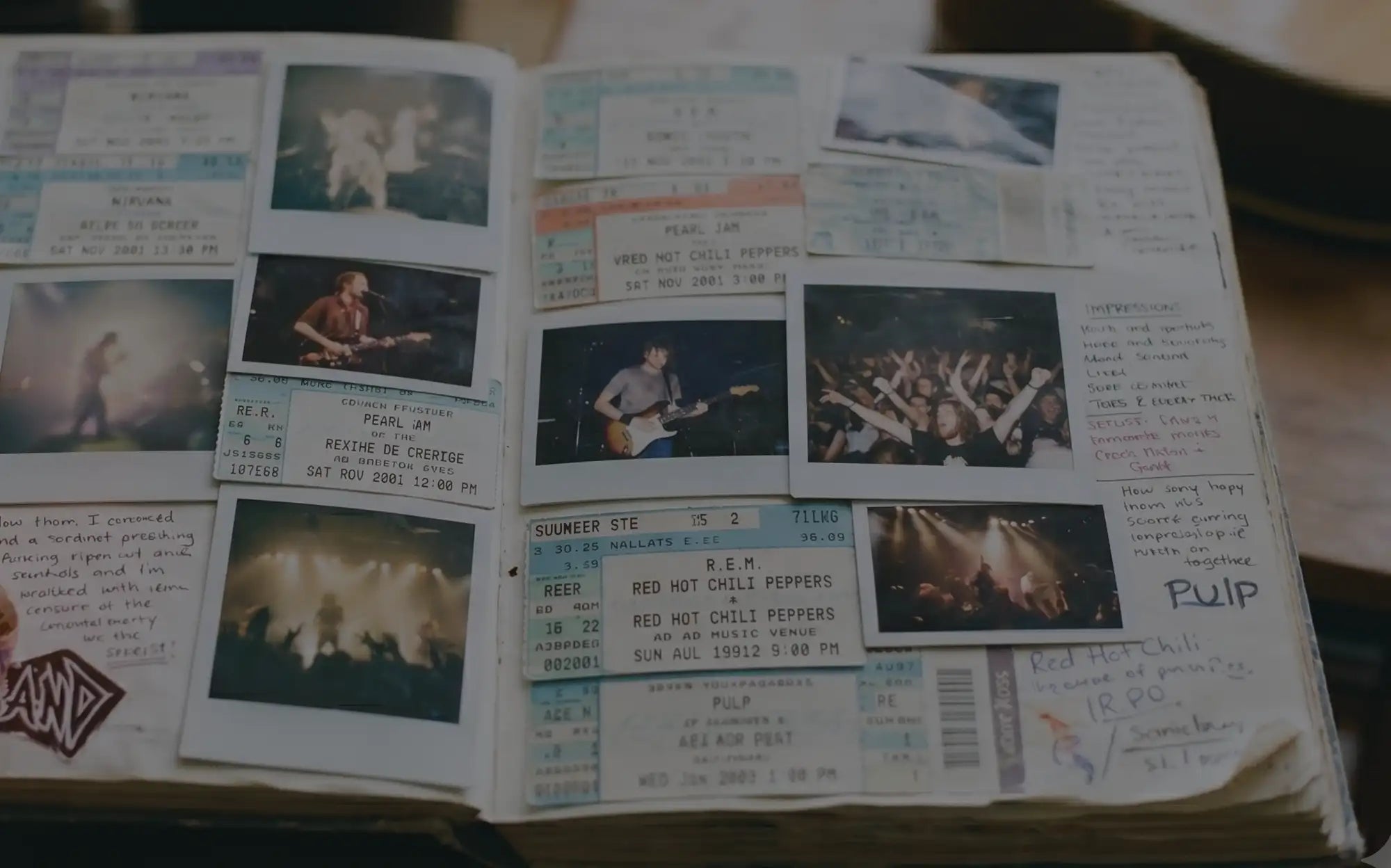
If you prefer paper, the Classic Edition journal creates a physical archive you can flip through. A shelf with three filled journals spanning a decade of shows is a different kind of object than an app screen, but it holds the same story. Some people use both. The app for quick stats and searchability. The journal for the shows worth reflecting on deeply.
The Gaps Tell Stories Too
One thing that surprises long-term trackers: the empty stretches are as revealing as the busy ones.
A six-month gap in your log isn't just "I didn't go to concerts for a while." It's usually something specific. A health issue. A breakup. A period of financial stress. A season of life where music wasn't the priority. You don't need to write any of that in your entries. The gap itself tells the story.
And the shows that bookend those gaps tend to matter more than average. The first concert after a long stretch away from live music often carries weight beyond what the performance justified. You weren't just seeing a band. You were coming back to something.
What Most People Regret
The most common thing people say when they start tracking concerts is some version of: "I wish I'd started this years ago."
Not because the tracking itself is transformative on day one. But because every show you attended before you started is a show you have to reconstruct from memory, old photos, and email receipts. Some of those shows are recoverable. Many aren't. The details are gone. If you want a guide for finding what you can, this walkthrough covers the best methods.
The shows you track going forward are different. They stay vivid. A single entry, even a short one, creates an anchor your brain can hold onto for years. That entry doesn't have to be detailed to work. Artist, date, venue, one sentence about the night. That's enough to keep the memory accessible.
The compound effect is the whole point. One entry is a note. A hundred entries is a biography you wrote without realizing it, one show at a time.
Starting Is the Only Hard Part
You don't need to go back and reconstruct your entire history before you start. You don't need to write a paragraph for every show. You don't need to be consistent from day one.
You just need to log the next concert you go to. Then the one after that.
A year from now, you'll have a list. Five years from now, you'll have a record. Ten years from now, you'll have something you can't build retroactively: a real-time account of a decade of live music and the life you lived around it.
That's what happens when you track 10 years of concerts. Not a spreadsheet. Not a stat line. A story.
FAQ
How many concerts do I need to track before patterns emerge?
Most people start noticing patterns around 25 to 30 logged shows. That's enough to see your most-visited venues, repeat artists, and busiest months. Deeper patterns (eras, companion trends, taste evolution) tend to show up around 50 to 70 entries, usually after two to three years of tracking.
What's the minimum I should write for each concert?
Artist, date, venue, and one sentence about the night. That takes under a minute and preserves more than memory alone will retain. You can always add more later, but a quick entry logged the day after beats a detailed entry you never write.
Should I go back and log old concerts before starting?
You can, but don't let it delay you. Start with your next show and track forward. If you want to fill in your history over time, the Concerts Remembered app lets you log past dates, and the Snapshot Edition is built for quick-logging up to 100 past concerts. But the priority is capturing shows while they're fresh.
Is a concert tracker app or a physical journal better for long-term tracking?
They serve different purposes. An app gives you automatic stats, searchability, and quick logging. A physical journal creates an artifact you can hold and flip through. Many long-term trackers use both: the app for every show, the journal for the ones worth deeper reflection.
What if I only go to a few concerts a year?
That's fine. Even 5 shows a year adds up to 50 over a decade. And when you don't go to concerts frequently, each one tends to carry more weight. Those are often the entries that become the most meaningful to look back on.
What kind of stats can I track over time?
Total shows, unique artists, most-seen artist, most-visited venue, busiest month, average concert frequency, who you go with most, ticket spending, rating trends, and your concert identity (whether you tend to revisit the same artists or explore new ones). The Concerts Remembered app tracks all of these automatically as you log shows.
Will I actually keep this up for 10 years?
The people who stick with it are the ones who keep it low-effort. Log every show, even if some entries are just the basics. The habit survives because it's quick, not because it's elaborate. Perfectionism kills consistency. A complete-enough log always beats an incomplete perfect one.
Share: