

You're in the parking lot after the encore and someone's talking to you from two feet away. You can see their mouth moving. You can hear a high whine that wasn't there at 7pm. By Tuesday it's quieter, and by Thursday you've forgotten about it until the next show.
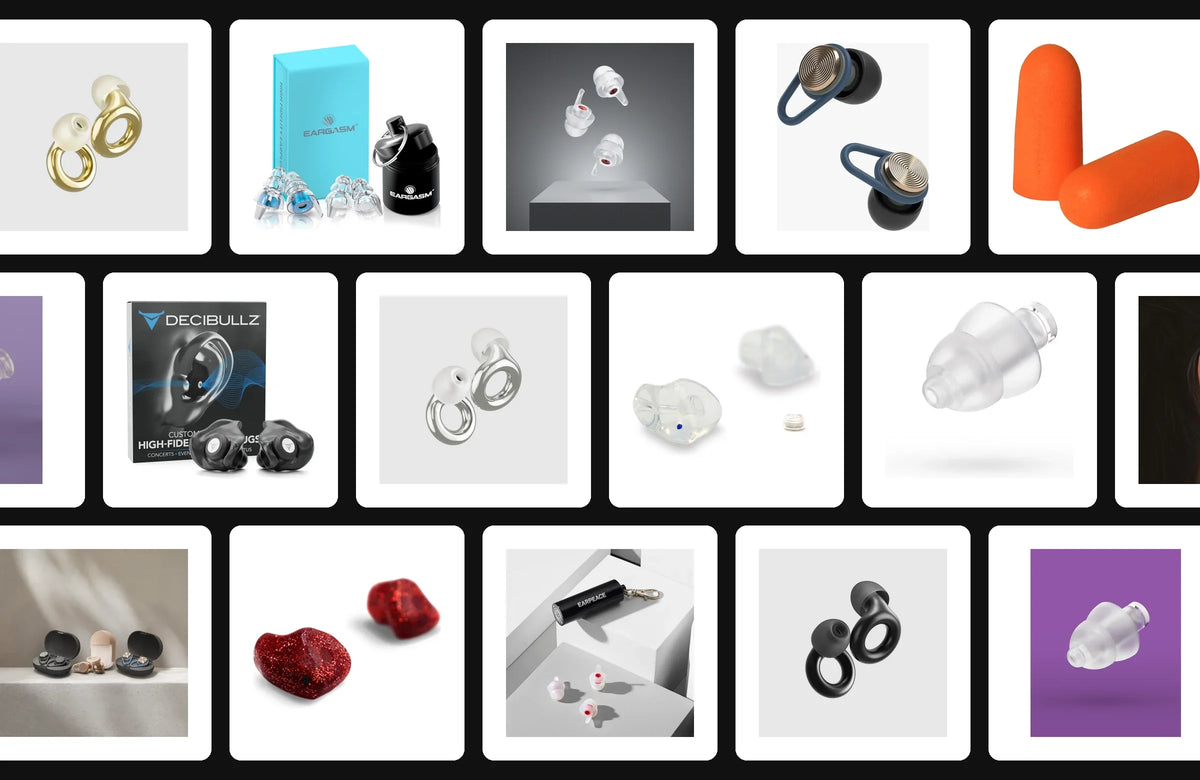
That whine is your ears telling you the night cost something. Concert earplugs fix it, and the good ones don't make the band sound like it's playing in the next room. Below are seven pairs we'd actually consider, from a $17 Alpine PartyPlug to a $199 custom mold (plus where the cheap orange foam ones fit), compared on the things that decide whether they work: how much they really cut, whether they stay sealed, and what the people who own them keep saying.
Some links in this guide are affiliate links: if you buy through them, we may earn a small commission at no extra cost to you. It never decides what makes the list.
Our Picks, Fast
- Best all-rounder: EarPeace Music ($31.95). Three filter strengths in the box, including the strongest rating on this list, so one pair covers a club show and a stadium.
- Best sound: Eargasm High Fidelity ($47.95, or $43.95 on Amazon). Ranked second of 56 earplugs in independent lab testing, if they fit your ears.
- Best for moshing and dancing: Loop Experience 2 ($34.95). The one owners say stays in when they move.
- Best on a budget: Alpine PartyPlug Pro ($24.95), or the plain PartyPlug ($16.95) if the price is everything.
- Cheapest protection: foam plugs like Howard Leight MAX (NRR 33), well under a dollar a pair. Muffled, but a great backup.
- Best if earplugs never stay in your ears: Decibullz High-Fidelity ($39.99). You heat them and mold them to your own ears at home.
- Best if you're at a show most weeks: 1 of 1 Pro 17 (from $199 plus ear impressions). Custom silicone made from impressions of your ears, with a flat 17 dB filter.
- The one we'd be careful with: Hears (about $43). Decent lab results, but the weakest owner ratings and service record here.
How We Researched This
We didn't build a lab. We did the legwork instead. For each pair we checked the brand's own spec sheet and which rating standard it uses, pulled Amazon US star ratings and review counts on November 18, 2026, and read through owner posts on Reddit, X and Amazon going back to May 2025, sorting the praise and complaints that kept coming up. Where independent measurements exist, mostly from the HearAdvisor lab's earplug rankings of 56 earplugs, we used them. Where they don't, we say so.
Nobody sent us these for free, and nobody saw this before it went up.
All Seven Side by Side
| Earplug | Fit type | Price (brand site) | Rated reduction (as labeled) | Rating standard | Ear tip sizes | Best for |
|---|---|---|---|---|---|---|
| Loop Experience 2 | Universal | $34.95 ($44.95 Plus) | 17 dB SNR / 12 dB NRR (+3 dB SNR with Mute) | Both | XS, S, M, L silicone (Plus adds foam) | Moshing, dancing |
| EarPeace Music | Universal, swappable filters | $31.95 | 17 / 20 / 26 dB SNR (11 / 14 / 19 dB NRR) | Both | Small, Standard | Every kind of show |
| Eargasm High Fidelity | Universal | $47.95 | 16 dB NRR | NRR | Standard and Small shells | Sound quality |
| Hears One / Hears Plus | Universal | about $43 | 20 dB SNR / 25 dB SNR | SNR only | XS, S, M, L | Testing with a return window |
| Alpine PartyPlug / Pro | Universal | $16.95 / $24.95 | 19 dB SNR / 21 dB SNR | SNR only | S, M, L | Budget, clubs |
| Decibullz High-Fidelity | Molded at home | $39.99 | 12 dB NRR | NRR | Molded shell plus S, M, L tips | Plugs that fall out |
| 1 of 1 Pro 17 | Custom from impressions | from $199 + impressions | 17 dB SNR, flat | EN 352-2 | Made from your ears | Weekly showgoers |
| For comparison: foam (Howard Leight MAX, 3M E-A-R Classic) | Disposable foam | well under $1 a pair in bulk | 33 / 29 dB NRR | NRR | One size, rolled to fit | Backup pair |
Prices are each brand's own US list price on November 18, 2026, before Black Friday codes.
What owners say, in numbers
| Earplug | Amazon US rating (reviews) | Most repeated complaint |
|---|---|---|
| Loop Experience 2 | 4.4 (16,869) | Muffled sound for some, and losing a plug or the Mute insert |
| EarPeace Music | 4.4 (4,261) | Some can't get them to stay in |
| Eargasm High Fidelity | 4.4 (19,108) | Falling out, or sitting too deep |
| Hears One / Plus | 4.0 (280) / 3.6 (228) | Customer service and returns |
| Alpine PartyPlug / Pro | 4.3 (520) / 4.4 (367) | Not enough bass cut on the plain PartyPlug |
| Decibullz High-Fidelity | 3.8 (507) | Discomfort and poor fit |
| 1 of 1 Pro 17 | Not sold on Amazon | Mixed: some say too much cut, some not enough |
Two things jump out. Loop, EarPeace and Eargasm all sit at 4.4 across thousands of reviews, so none of them is a bad buy. And Hears and Decibullz score noticeably lower on Amazon than on their own websites, where Hears shows 4.8 stars.
The Number on the Box Isn't What Reaches Your Ears
Every pair above prints a decibel number, and almost nobody reads it right.
NRR and SNR aren't the same scale
There are two rating systems on these boxes. NRR (Noise Reduction Rating) is the US label required by the EPA under 40 CFR Part 211, tested to the ANSI S3.19 method. SNR (Single Number Rating) is the European figure that goes with EN 352 certification. They're measured and calculated differently, so you can't line them up.
You can see the gap in this list. Every brand here that prints both numbers shows SNR running 5 to 8 dB higher than NRR for the same plug: Loop is 17 SNR and 12 NRR, EarPeace's red filter is 20 SNR and 14 NRR, and the Decibullz Professional is 15 SNR and 7 NRR. So when Hears says 20 dB and Eargasm says 16 dB, Hears isn't automatically stronger. One is SNR and the other is NRR. Compare SNR to SNR or NRR to NRR, and treat the rest as rough.
Sorted by the label they carry, the seven split into two camps.
- NRR on the box (US-style): Eargasm (16), Decibullz High-Fidelity (12), foam plugs (29 to 33), plus Loop and EarPeace, which print both.
- SNR only (European-style): Hears (20 or 25), Alpine (19 or 21), and the 1 of 1 Pro 17 (17, certified to EN 352-2).
Brands and reviewers mix these up constantly. We found the Loop Experience 2 described as 12, 17 and 18 dB in different places, and Eargasm as both 16 and 21. Eargasm's 21 is its own "expected reduction" figure, not a standard rating. When in doubt, go by the label printed on the box.
The lab number is a best case
Ratings come from a lab panel wearing the plug exactly as directed. Real ears, real insertions and three hours of singing along don't match that.
The US workplace rule of thumb in OSHA's technical manual takes the NRR, subtracts 7 and then halves what's left. Run a 12 NRR plug through that and you're left with 2.5 dB of credit. That's harsh, because it's built for workers who wear plugs badly all shift. It still makes the point: a low NRR on the box is a ceiling, not a promise.
A tiny leak can make things worse than no plug at all
This is the one that changed how we think about fit. In HearAdvisor's lab testing of the original Loop Experience, a shallow insertion with an air gap the width of a needle created a resonance around 1,300 Hz that made sound at the eardrum 12 dB louder than wearing nothing. A half-seated earplug isn't a weaker earplug. At some frequencies it's an amplifier.
What the dB actually buys you at a loud show
When researchers in Amsterdam put 51 people through a 4.5-hour outdoor festival, the sound averaged 100 dBA. Only 8% of the group wearing earplugs showed a temporary hearing shift afterward, against 42% of the group without them (JAMA Otolaryngology, 2016). The WHO's 2022 global standard for safe listening venues sets the recommended ceiling for venues at an average of 100 dB over any 15 minutes.
NIOSH sets its limit at 85 dBA for eight hours and halves the time for every 3 dB louder (CDC/NIOSH). It's a workplace limit, but NIOSH itself says protecting your ears at 85 dBA and up is good practice anywhere. Applied to a 100 dBA room, here's what the reduction at your eardrum buys you:
| Real reduction at your ear | What you hear in a 100 dBA room | Time before you hit the daily limit |
|---|---|---|
| None | 100 dBA | 15 minutes |
| 6 dB (bad seal) | 94 dBA | 1 hour |
| 10 dB | 90 dBA | about 2.5 hours |
| 12 dB | 88 dBA | 4 hours |
| 15 dB | 85 dBA | 8 hours |
| 20 dB | 80 dBA | more than a full day |
A three-hour night with two openers needs somewhere around 12 dB of real reduction to stay inside the limit. Most pairs here can deliver that with a proper seal. Few of them can with a sloppy one.
Ready to Wear: The Universal-Fit Picks
EarPeace Music: best all-rounder

$31.95 · 17, 20 or 26 dB SNR (11, 14 or 19 dB NRR) · two sizes · aluminum case
EarPeace's trick is the box. You get three sets of filters (clear 17 dB, red 20 dB, black 26 dB SNR), three plugs in small and three in standard, and an aluminum case with room for the spares. The filters pop out of the soft silicone body in a couple of seconds, so you can run clear at a quiet club set and swap to black when you end up on the rail at an arena. The black filter's 26 SNR (19 NRR) is the strongest rating in our main comparison, and it's also the cheapest of the big three.
What owners say: EarPeace has fewer reviews than Loop or Eargasm but the same 4.4 stars on Amazon, from more than 4,200 buyers, and 4.86 on its own site. The fans it has are loyal. "Earpeace have been my go to," wrote one r/festivals regular, and an Amazon buyer who ran the black filters at a loud show called them "an amazing product." The third plug in the box gets thanked a lot, because someone always drops one in a field. In an October 2025 r/Concerts poll it was a distant third, with 7 votes to Eargasm's 32 and Loop's 30, so it's less hyped than it deserves.
The catch: Fit, for some ears. Amazon's review summary flags buyers who find them hard to keep in. Try the small size before giving up on them. There's also no independent lab test of this exact model. The lab data that exists covers its pricier sibling, the Music PRO.
Get it if: you go to a mix of venues and want one pair that handles all of them.
Eargasm High Fidelity: best sound

$47.95 on Eargasm's site ($43.95 on Amazon) · 16 dB NRR · standard and small shells · aluminum keychain case
If you care how the guitars sound, this is the pair. In HearAdvisor's lab rankings the Eargasm High Fidelity came second of the 56 earplugs tested, with a Grade A. It's also the fan favorite: it took the most votes in that October 2025 r/Concerts poll. You get one filter, two shell sizes, a gift box and an aluminum case. Eargasm has since added a MAX Edition ($69.95), sold as 27 dB of reduction, for anyone who wants this sound with more cut.
What owners say: The praise is all about clarity. One Redditor who'd tried both said Eargasm gave "more clarity in the highs" than Loop, and another wrote that the music was clear and they could still talk to the person next to them. The complaints are all about fit. "I have to keep shoving them back in every 2 mins," wrote one r/Concerts poster, and others say they sit too deep or hurt after a while. On Amazon, fit is the most divided topic of any pair on this list.
The catch: If your ears are on the small side, these may not stay in. Try the small shells first, or look at Eargasm's separate Smaller Ears model. And buy from Amazon if you can: it was $4 cheaper than Eargasm's own site when we checked.
Get it if: sound quality is the reason you've avoided earplugs so far, and you've never had trouble keeping plugs in.
Loop Experience 2: best for moshing and dancing

$34.95 ($44.95 for Plus) · 17 dB SNR / 12 dB NRR · XS to L tips · keychain case
Loop is the earplug people recognize, and it has the biggest following here: 4.4 stars from nearly 17,000 Amazon reviews. The ring sits in your outer ear and the shape locks in. The standard box has four silicone tip sizes. The Plus adds foam tips in three sizes and the Mute insert, which Loop says adds 3 dB SNR (15 NRR in total) when the room gets brutal.
What owners say: The number-one compliment is that they stay put. "Never once fell out of my ears," as one fan put it after a show, and people with piercings say they work around them. The complaints split two ways. Some owners say Loops muffle the sound too much, and one r/Concerts poll starter said exactly that. Others lose things: a single plug, or the Mute inserts, which a few people say stop the case closing properly. Singing along sounds boomy in your own head too, which is common with plugs that seal well.
The catch: Sound and strength. In HearAdvisor's lab the Experience 2 Plus ranked 37th of 56 in its standard setup and dropped further with the Mute in. At 12 NRR it's on the lighter side for an arena, so if you buy Loop for big rooms, buy the Plus and use the Mute and foam tips.
Get it if: you move a lot at shows, or you've tried subtle plugs and never actually worn them.
Alpine PartyPlug and PartyPlug Pro: best on a budget

PartyPlug $16.95, 19 dB SNR · PartyPlug Pro $24.95, 21 dB SNR · S, M, L tips · keychain case
Alpine is a Dutch hearing protection company, and both PartyPlugs are soft, silicone-free and low-profile. Alpine updated both in October 2026 with three tip sizes in the box and an improved filter, keeping the same ratings, so older reviews may describe the previous version.
The Pro is the one we'd buy, and Alpine's own test data is the reason. The plain PartyPlug cuts treble much harder than bass: in the H/M/L breakdown on its spec sheet it's 20, 17 and 13 dB, and at the deepest frequencies it cuts very little. The Pro reads 20, 20 and 19, which is about as flat as plugs get. That gap is $8.
What owners say: Comfort comes up again and again, along with being able to talk to friends without pulling them out. The plain PartyPlug gets one pointed complaint, from a buyer on Alpine's own site who called its bass protection "dangerously inadequate." That matches Alpine's figures. On Reddit the Pro is the one people recommend for balanced sound.
The catch: No independent lab has measured either one. The plain PartyPlug lets the bass through, which some people like at an EDM show and others find muddy at a rock show.
Get it if: you want a good pair in every bag you own, or you're buying for someone who's never worn earplugs and might lose them.
Hears: the one we'd be careful with

About $43 on Hears' site · 20 dB SNR (One) or 25 dB SNR (Plus) · XS to L tips · keychain case
Hears is the newest name here and the one you've most likely seen in an ad. It comes in two strengths, Hears One at 20 dB SNR and Hears Plus at 25 dB SNR. You get four tip sizes in soft TPE, a keychain case, a 2-year warranty and a 100-day return window.
On paper it's solid. HearAdvisor's lab ranked the 20 SNR version 21st of 56, with a Grade B, well ahead of the Loop Experience 2 Plus. Owners who like them talk about clarity and comfort.
What owners say: This is where it falls apart. Hears shows 4.8 stars on its own site, but on Amazon it's 4.0 for the One and 3.6 for the Plus, and one review in six for the Plus is one star. On Reddit the most repeated complaint isn't the sound, it's the company. "Customer support is near non existent," wrote one r/earplugs poster, and others describe paying for return shipping, slow or incomplete orders, and plugs that feel cheaply made. Several glowing reviews we found turned out to be sponsored articles.
The catch: Hears was much cheaper on Amazon than direct when we checked, at $23 for the One and about $29 for the Plus. If you want to try them, that's the lower-risk way to do it.
Get it if: you've read all of the above and still want to test them. Otherwise EarPeace's black filter gives you a stronger rating for less money.
The Cheap Option: Foam Earplugs (and the $20 Step Up)

The orange and yellow foam plugs from the hardware store are the strongest thing on this page, at least on paper. Howard Leight MAX is rated NRR 33 and the 3M E-A-R Classic is NRR 29, both well above any filtered plug here. A box of 200 pairs costs roughly $40 to $70, so you're paying cents per show.
They lose on sound. Conventional earplugs cut high frequencies 15 to 20 dB more than low ones, according to The Hearing Review, which is why everything sounds like it's coming through a wall. The kick drum and bass come through. The vocals and cymbals mostly don't. That's the reason people pull foam out by the third song, and a plug in your pocket protects nothing.
Foam also only works if it's in properly. Roll it into a tight, thin cylinder, pull the top of your ear up and back, slide it in, and hold it with a fingertip while it expands, about 20 to 30 seconds. If more than a little of it is sticking out of your ear, it isn't deep enough. Foam is basically single use, too: toss a pair after a show or two.
Where foam makes sense: as the backup in every bag, jacket and glovebox. As a second layer for a punishing room, like a metal show right next to the subs. Or the night you forget your good pair.
The $20 step up: if the budget is tight but you want music to still sound like music, the Etymotic ER20XS is the classic cheap filtered plug, at about $20. Etymotic rates it NRR 13 and says it gives about 20 dB of reduction across frequencies when fitted properly. It's been around for years and isn't exciting to look at, which is the only reason it isn't in our main seven.
Molded to Your Ears: Decibullz and Custom Plugs
Universal plugs fail for one reason more than any other. They don't fit the person wearing them. If you've had pairs work loose by the second song, molded plugs are the fix, and there are two very different ways to get them.
Decibullz High-Fidelity: mold them yourself

$39.99 · 12 dB NRR · molded shells plus S, M, L triple-flange tips · pouch
Decibullz shells are thermoplastic. You drop them in hot water for 3 to 5 minutes, let them cool until they're warm and soft, then press them into the bowl of your ear so they take its shape. A high-fidelity filter sits inside. If the fit's off, you reheat and do it again. Take out any piercings in that part of your ear first, and don't put them in while they're still hot.
There's also a Decibullz Professional High-Fidelity at $79.99 on sale ($99.99 list), with a hard case, foam and silicone tips and a different filter (15 dB SNR, 7 NRR). Owners who like it say the sound is more natural than most universal plugs.
What owners say: Split. People whose molding works describe a near-perfect fit and great clarity. But both models sit at 3.8 stars on Amazon, and about one review in six for the High-Fidelity is one star, mostly about discomfort and fit. Some Professional buyers report the shells melting. A few say they don't cut enough for very loud bands.
The catch: 12 NRR is modest, and an at-home mold is only as good as your molding. We found no independent lab data for either model.
Get it if: universal plugs fall out of your ears, you're not ready to spend $200, and you're patient enough to remold once or twice.
1 of 1 Pro 17: true custom

From $199 ($209 to $219 for metallic, sparkle and glow colors) plus ear impressions · 17 dB SNR, flat
This is the real thing. 1 of 1 Custom is the company behind ACS Custom in the Americas: it was ACS Custom USA and took over ACS's manufacturing and distribution here in 2016. It makes plugs in soft medical-grade silicone from impressions of your ear canals, then fits the PRO17 filter.
The PRO17 spec sheet shows 17 dB SNR, with 16 dB across highs, mids and lows, tested to EN 352-2. That's about as flat as hearing protection gets. 1 of 1 rates it as safe up to 105 dB for four hours, which lines up with the NIOSH math (105 minus 17 is 88 dBA, and NIOSH allows four hours at 88). No US NRR is published.
Ordering takes four steps, and the first one happens in person, not online.
-
Get impressions. Free with purchase at a 1 of 1 location (Burlingame, California; Venice in Los Angeles; a weekly day in Manhattan; and Denver every two weeks), or $50 to $200 at your own audiologist or ENT. They don't do at-home impression kits, because they say those can't get a deep enough fit.
-
Wait. Plugs ship about 3 to 4 weeks after the lab gets your impressions. Rush production costs extra.
-
Check the fit. You get a 45-day fit warranty with a free remake. After that, remakes cost money and stop being covered at three months.
-
Swap filters if needed. You can exchange filters within 45 days if 17 dB turns out to be too much or too little. A softer PRO15 and stronger PRO26 exist.
What owners say: The fit is the headline. "Best fit and seal I've experienced," wrote one r/aves regular. The filter splits people. Some find the PRO17 blocks more than they'd like and prefer the softer PRO15. At least one owner who relied on the 17 at a very loud show still left with ringing ears. And one new owner wondered out loud whether their old Loops had done a better job, which is worth knowing before you spend $200.
The catch: You can't try before you buy, you wait a month, and you need to get to a fitting location or an audiologist. On the plus side, 1 of 1 keeps your impressions on file for four years, so a lost plug doesn't mean another appointment.
Get it if: you're at a show most weeks, you play in a band, or you've already lost two pairs of universal plugs this year.
Head to Head
Loop Experience 2 vs Eargasm. This is the matchup fans argue about most, and the r/Concerts poll was nearly a tie. Eargasm sounds better and Loop stays in better. If you stand and watch, get Eargasm. If you're in the pit, get Loop, ideally the Plus.
Loop Experience 2 vs EarPeace Music. Close on comfort and price, but EarPeace wins on range. The black filter's 19 NRR beats Loop's 12, and with the Mute in, Loop still only reaches 15 NRR. You also get a spare plug. Loop wins on staying put in a crowd.
Hears vs EarPeace. Hears Plus is rated 25 SNR. EarPeace's black filter is rated 26 SNR, costs less, comes with two other strengths, and has a far better owner record.
Alpine PartyPlug vs PartyPlug Pro. Spend the extra $8. The Pro's filter is close to flat, and the plain PartyPlug lets the bass through.
Foam vs any filtered plug. Foam blocks more on paper and costs cents. A filtered plug sounds like the show. Wear the filtered pair, and carry the foam as backup.
Decibullz vs 1 of 1 Pro 17. Both solve fit. Decibullz costs $40 and you do the molding. The Pro 17 costs five times as much and a professional takes the impressions, so you get a deeper, more even seal and a flatter filter. If you're unsure, start with Decibullz. You'll know within two shows whether fit was your problem.
How to Wear Them So They Actually Work
Most bad earplug experiences are insertion problems, not product problems.
- Try every tip size at home. The pre-installed medium isn't your size by default. Put one in, then talk. Your voice should sound a little boomy and closed in. If it sounds exactly like normal, you don't have a seal.
- Pull your ear up and back. Reach over your head with the opposite hand, lift the top of your ear, and slide the plug in. It straightens the canal.
- Put them in before the first song. The opener's first song is still loud. Don't wait for it to hurt.
- Reseat them between sets. Singing, shouting and chewing all walk plugs out. Give each one a press when the lights come up.
- Clip the case to your keys. Losing plugs is one of the most common complaints across every brand here, and the plugs you forgot at home protect nothing. Two days before each show, the Concerts Remembered Pre-show Brief lands with artist and venue tips and the likely playlist. We use it as the reminder to find the case before we're heading out the door.
- If you forget them, ask. Arena first-aid stations and some bars keep free foam plugs.
You'll still feel the kick drum in your chest with good plugs in. That's your ribcage, not your ears, and it's exactly how it should feel.
Which Pair We'd Buy
Fit beats specs. A 14 NRR plug that's sealed all night does more than a 25 SNR plug that's half out by the encore. So buy the pair you'll wear, then wear it properly.
- First pair, or going to a mix of shows: EarPeace Music. Start on the red filter.
- Sound matters most and your ears aren't small: Eargasm High Fidelity.
- You're in the pit or on the barricade: Loop Experience 2 Plus, with the Mute for arenas.
- Buying several, or buying a gift for someone who loses things: Alpine PartyPlug Pro.
- Tightest budget: Etymotic ER20XS for about $20, with a box of foam for backups.
- Every pair falls out: Decibullz High-Fidelity, then customs if that fixes it.
- You're at a show most weeks: 1 of 1 Pro 17. It's the last pair you'll buy for years.
One habit makes the next pick easier. After each show, log it in the Concerts Remembered app, give the Sound Quality rating an honest score, and add a line in Your Take (the private venue notes in Venue Room) about which filter you wore and where you stood. Next time you're back in that room, you'll know whether the red filter was enough or you need the black one.
Everyone has a loudest show (it's one of the ten questions in the concert questionnaire people pass around), and it's usually the one you didn't protect your ears at. For the rest of what goes in the bag, see our concert essentials checklist, and if you're shopping for someone else, the hearing protection picks in our gift guide.
FAQ
What are the best earplugs for concerts?
For most people, EarPeace Music is the best all-rounder because one $31.95 box covers quiet clubs to stadiums with three filter strengths. Eargasm High Fidelity sounds the most natural if it fits your ears, Loop Experience 2 stays in best when you're moving, and the Alpine PartyPlug Pro is the best budget pair at about $25. If you're at a show most weeks, custom plugs like the 1 of 1 Pro 17 are worth it.
How many decibels should concert earplugs reduce?
Aim for at least 12 dB of real reduction at your ear, and more for arenas. Loud shows average around 100 dBA, and NIOSH's limit at that level is 15 minutes. Cutting 12 dB stretches that to about four hours, and 15 dB to about eight. Remember that the box shows a lab best case, and a poor seal can cut the real figure in half or worse.
Is NRR or SNR better?
Neither is better. They're different scales. NRR is the US rating and SNR is the European one, and for the same plug SNR usually reads several dB higher. In this list, brands that print both show SNR 5 to 8 dB above NRR. Only compare plugs that use the same rating.
Are cheap foam earplugs OK for concerts, or do I need high-fidelity ones?
Foam is fine for protecting your ears, but high-fidelity plugs are better for music. Foam blocks more on paper (NRR 29 to 33 against 12 to 19 for most filtered plugs), but it cuts high frequencies far more than low ones, so the band sounds muffled and people pull them out. High-fidelity plugs turn everything down more evenly, so the mix still sounds like the mix. Foam is still much better than nothing, and it makes a good backup.
Are custom-molded earplugs worth it?
Custom plugs are worth it if you go to shows most weeks, play music, or can't get universal plugs to stay in. They seal more consistently and usually sound flatter. Expect to pay from $199 to about $420 depending on color and who takes your impressions, and to wait three to four weeks. If you go to a handful of shows a year, a $30 to $45 universal pair does the job.
Can I wear Loop earplugs to a concert?
Yes, Loop Experience 2 is built for concerts. Loop Quiet blocks more sound and will muffle music, and Loop Dream is made for sleep. For concerts, get the Experience 2, or the Experience 2 Plus if you want the Mute insert for louder rooms.
Why do my ears still ring after wearing earplugs?
Usually the seal. A plug that's sitting shallow or has worked loose lets sound around it, and lab testing has shown a tiny gap can make some frequencies louder than wearing nothing. Try a different tip size, insert while pulling your ear up and back, and reseat between sets. If it still happens at very loud shows, step up to a stronger filter. If ringing lasts more than a day or two, see an audiologist.
What happens if I forget my earplugs?
Ask at the venue. Arena first-aid stations and many bars keep free foam plugs, and they're far better than nothing. Then keep a cheap backup pair, like Alpine PartyPlugs or a few foam plugs, in your bag or car so it doesn't happen again.
Turn It Down, Not Off
Good earplugs don't take anything away from the night. They take away the whine in the parking lot and the muffled Tuesday after. Pick the pair that fits, keep the case on your keys, and when you get home, log the show in the Concerts Remembered app with a note on how loud it was. Future you, standing in the same room next year, will want to know.

Share: